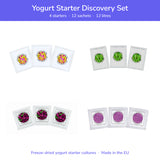
Which L. reuteri strain does it contain?
On the pack and on this page we list the four bacterial species in the blend: L. reuteri, L. salivarius, L. bulgaricus and S. thermophilus. That's normal for starter cultures sold for making yogurt at home. In the UK, EU and US, food labelling rules ask for accurate ingredients, allergens, storage and date information, but they generally don't require individual strain codes on a starter culture like this one. Strain-level detail mainly matters when a product makes claims about a particular strain, and we don't make health claims.
Behind the scenes, our manufacturer keeps full records of every strain for traceability and quality checks. The L. reuteri in this blend is the manufacturer's own strain, chosen to work alongside the other three cultures, rather than one of the single research strains that 36-hour recipes are built around. You can read more in why we don't list strain codes, and if you have a technical question about the cultures, email us with the best-before date on your pack and we'll help.
What if my first batch doesn't set?
Just email us. We'll refund the first sachet you used and help you get the next batch right. It nearly always comes down to the temperature or the milk, and both are easy to fix.
Do I need a yogurt maker?
Not necessarily. Any device works as long as it keeps a steady 40–45°C (104–113°F) for the entire incubation: an electric yogurt maker, an Instant Pot on its yogurt setting, or a well-insulated container. Electric yogurt makers are the easiest because they hold the temperature for you; with other setups, check now and then with a thermometer that it stays steady. The timings are the same in any of them: 12–16 hours for the first batch from a sachet, 3–6 hours for batches made with your ready yogurt.
Can I use 36-hour L. reuteri recipes?
There's no need. Your first batch, made with a sachet and milk, sets in 12–16 hours at a steady 40–45°C (104–113°F), and later batches made with your ready yogurt take 3–6 hours, in a yogurt maker or any device that keeps the temperature stable. Those 36-hour recipes were designed for single-strain cultures, and leaving this blend that long just makes your yogurt more and more sour.
Can I keep reusing my yogurt?
Absolutely, and that's the beauty of it. Save three tablespoons from each fresh batch and use them to start your next litre. Batches made with your ready yogurt take just 3–6 hours (the first batch from a sachet takes 12–16 hours), as long as your yogurt maker or device keeps the temperature stable. If setting starts to slow down, or the smell or texture changes, it's time to open a fresh sachet.
Can I use plant-based milk?
You can. Soy and cashew milk both work, but expect a softer set than dairy and a little more variation from batch to batch. Pick a milk without preservatives, warm it gently rather than boiling it, and expect reculturing to be less reliable than with dairy (more on choosing milk). One thing to know: the starter contains traces of milk and lactose, so it isn't vegan or dairy-free.
What's the CFU count?
Here's the interesting part: the bacteria in the sachet are just the beginning. Once they meet warm milk they multiply, so the count in your finished yogurt depends far more on your milk, temperature and timing than on the sachet itself. Want to dig deeper? Read how many bacteria you get from probiotic foods and why pH matters more than time. For product-specific figures, email us with the best-before date on your pack and we'll help.