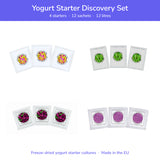
Do I need a yogurt maker?
No. A yogurt maker, or any device that keeps a steady 40–45°C (104–113°F) for the whole incubation, gives a thick, spoonable kefir in 12–16 hours for the first batch. Kefir also cultures at room temperature: it's slower, usually 24–48 hours for the first batch and up to several days in colder months, and gives a pourable, drinkable kefir.
What if my first batch doesn't set?
Just email us. We'll refund the first sachet you used and help you get the next batch right. It nearly always comes down to the temperature or the milk, and both are easy to fix.
How long do later batches take?
Once you have your first batch, start the next one with 3 tablespoons of ready kefir and a litre of milk. In a yogurt maker it takes just 3–6 hours; at room temperature, about a day, or longer when it's cold.
Will it make kefir grains?
It can. Under ideal conditions, repeated batches made from the freeze-dried starter can grow small kefir grains. You don't need them, though: you can simply keep reculturing with spoonfuls of ready kefir (starter or grains? our kefir guide explains).
Can I keep reusing my kefir?
Yes. Save three tablespoons from each fresh batch and use them to start your next litre. Batches made with your ready kefir take just 3–6 hours (the first batch from a sachet takes 12–16 hours) in a yogurt maker. If setting starts to slow down, or the smell or texture changes, it's time to open a fresh sachet.
Can I use plant-based milk?
You can. Soy and cashew milk both work, but expect a softer set than dairy and a little more variation from batch to batch. Pick a milk without preservatives, warm it gently rather than boiling it, and expect reculturing to be less reliable than with dairy (more on choosing milk). One thing to know: the starter contains traces of milk and lactose, so it isn't vegan or dairy-free.
Which cultures does it contain?
Lactic bacteria: Lactococcus lactis subsp. cremoris, Lactococcus lactis subsp. lactis, Lactococcus lactis subsp. lactis biovar diacetylactis, Streptococcus thermophilus, Lactobacillus delbrueckii subsp. bulgaricus, Lactobacillus kefir, Lactobacillus parakefir.
Kefir yeasts: Saccharomyces cerevisiae, Kluyveromyces lactis. The same culture names are printed on every pack and listed in the specifications above.
What's the CFU count?
Here's the interesting part: the bacteria in the sachet are just the beginning. Once they meet warm milk they multiply, so the count in your finished kefir depends far more on your milk, temperature and timing than on the sachet itself. Want to dig deeper? Read how many bacteria you get from probiotic foods and why pH matters more than time. For product-specific figures, email us with the best-before date on your pack and we'll help.